Research Article | | Peer-Reviewed

Optimization of the Parameters of a Helical Rotary Harrow Based on the Method of Mathematical Planning of Experiments

Received: 14 May 2026     Accepted: 25 May 2026     Published: 26 June 2026
Views:       Downloads:
Abstract

This article investigates the optimization of the constructive and technological parameters of a helical rotary harrow using the method of mathematical planning of multifactor experiments. The study aims to improve the quality of soil cultivation while reducing energy consumption and increasing the operational efficiency of the unit. In the research, the influence of the rotational speed of the helical toothed section, tooth diameter, tooth length, helix rise angle, and aggregate travel speed on the quality and energy performance indicators of the rotary harrow was analyzed. The experiments were carried out based on the Plan B5 experimental design method. The lifting height of the bottom soil layer, soil crumbling degree, power consumption of the rotary harrow, and specific draft resistance were selected as evaluation criteria. Experimental data were processed using the PLANEX software package. The homogeneity of variance was evaluated using Cochran’s criterion, the significance of regression coefficients was determined by Student’s criterion, and the adequacy of the developed models was verified using Fisher’s criterion. As a result of the study, regression equations describing the relationships between the input factors and evaluation criteria were obtained, and the optimal constructive and technological parameters of the helical rotary harrow were determined. The obtained results demonstrate that the proposed parameter optimization improves soil cultivation quality, decreases energy consumption, and enhances the operational efficiency of the machine unit.

Published in International Journal of Mechanical Engineering and Applications (Volume 14, Issue 2)
DOI 10.11648/j.ijmea.20261402.11
Page(s) 28-35
Creative Commons

This is an Open Access article, distributed under the terms of the Creative Commons Attribution 4.0 International License (http://creativecommons.org/licenses/by/4.0/), which permits unrestricted use, distribution and reproduction in any medium or format, provided the original work is properly cited.

Copyright

Copyright © The Author(s), 2026. Published by Science Publishing Group

Keywords

Rotary Harrow, Helical Tooth, Mathematical Planning, Multifactor Experiment, Optimization, Regression Equation, Soil Cultivation, Energy Consumption

1. Introduction
High-quality soil cultivation in agriculture is one of the important factors for increasing crop productivity and introducing resource-saving technologies. Under modern conditions, the improvement of tillage machines aimed at preserving soil structure, reducing energy consumption, and improving tillage quality is considered an urgent task. In this regard, rotary harrows are distinguished by their effective implementation of soil loosening, crushing, and mixing processes. In particular, helical-toothed rotary harrows ensure a uniform effect on the soil due to the special design of their working bodies, thereby increasing the quality of operation and the productivity of the unit.
The theoretical foundations of tillage machines were developed by V. P. Goryachkin, who investigated the interaction processes between the soil and the working body . In the works of A. N. Zelenin, issues of soil resistance and energy consumption were studied . V. A. Sakun analyzed the kinematic and technological parameters of rotary working bodies . A. P. Taveryan investigated the kinematic characteristics of tillage devices with planetary drives .
Uzbek scientists have also carried out a number of scientific studies on the improvement of tillage machines. In particular, the works of D. J. Mukhamedov investigated the influence of rotary working bodies on soil and the indicators of tillage quality . D. Abduvakhobov conducted studies on optimizing the technological parameters of tillage units and determining energy-saving operating modes . In the scientific works of Tokhtakuziev, the kinematic parameters of rotary and milling working bodies and their effect on soil crushing were analyzed . Q. Ismatullaev studied the constructive parameters of tillage devices and their influence on agrotechnical indicators .
In addition, B. M. Mirzaev carried out studies on energy-saving constructions of combined tillage units and the parameters of their working bodies . In the works of N. R. Ravshanov, methods of mathematical modeling and processing experimental results were applied to agricultural machinery . F. M. Mamadaliev analyzed the process of soil interaction with rotary working bodies and the factors affecting the degree of soil crushing .
The method of mathematical planning of experiments is considered an effective approach in the optimization of technical systems. In the works of V. V. Nalimov and Yu. P. Adler, the theoretical foundations of multifactor experimental design and methods of mathematical modeling were widely described .
The analyzed scientific studies show that the issue of comprehensive optimization of the parameters of helical-toothed rotary harrows based on multifactor experiments has not been sufficiently studied. Therefore, in this research work, the influence of the rotational speed of the helical-toothed section of the rotary harrow, tooth diameter, tooth length, helix rise angle, and the travel speed of the unit on tillage quality and energy performance indicators was investigated using the method of mathematical planning of experiments.
2. Materials and Research Results
To determine the optimal values of the parameters of the helical-toothed rotary harrow studied in theoretical and single-factor experiments, the method of mathematical planning of multifactor experiments was used .
To conduct the research, the rotational speed of the helical-toothed sections of the rotary harrow, the diameter and length of the tooth, the helix rise angle, and the travel speed of the unit were selected as factors influencing its quality and energy performance indicators.
Based on the above-mentioned theoretical studies and single-factor experiments, the values of the factor levels and variation intervals were determined (Table 1).
Table 1. Factors, their symbolic designations, variation intervals, and levels.

Name of Factors

Factors

Factor Levels

Unit of Measurement

Symbolic Designation of Factors

Variation Interval

-1

0

+1

Rotational speed of the helical-toothed section of the rotary harrow

r/min

Х1

50

250

300

350

Diameter of the helical tooth

Mm

Х2

10

40

50

60

Length of the helical tooth

Х3

20

160

180

200

Helix rise angle of the tooth

Х4

5

25

30

35

Unit travel speed

km/h

Х5

1

5

6

7

The influencing, i.e. input factors, were coded as follows:
X1 – rotational speed of the helical-toothed section of the rotary harrow;
X2 – diameter of the helical tooth of the rotary harrow, mm;
X3 – length of the helical tooth of the rotary harrow, mm;
X4 – helix rise angle of the rotary harrow tooth,°;
X₅ – travel speed of the unit, km/h.
Assuming that the effect of the factors on the evaluation criteria is fully described by a second-order polynomial, the experiments were carried out according to the Plan B5 design .
In conducting the multifactor experiments, the lifting height of the soil at the bottom of the treated layer Y1 (cm), the degree of soil crumbling (Y2, %), i.e. the proportion of fractions smaller than 25 mm, the power consumed by the rotary harrow (Y3, kW), and the specific draft resistance (Y4, N) were accepted as evaluation criteria. The plan for conducting multifactor experiments and their results are given in Table 1 in the appendix.
The data obtained in the experiments were processed using the “PLANEX” program. In this case, Cochran’s criterion was used to assess the homogeneity of variance, Student’s criterion was used to assess the significance of regression coefficients, and Fisher’s criterion was used to assess the adequacy of regression models.
The experimental results were processed in the indicated order, and the following regression equations adequately describing the evaluation criteria were obtained:
for the lifting distance of the bottom of the treated layer (cm):
Y=+4,6228-1,1139X1-0,7550X2-0,9293X3+0,4443X4+0,3665X5-0,0928X1^2-0,1490X1X2-0,1598X1X3+0,0498X1X4+0,0877X1X5+0,3872X2^2-0,2135X2X3-0,1240X2X4-0,0610X2X5+0,1922X3^2-0,0673X3X4+1,0006X4^2+0,1619X4X5+1,0006X5^2(1)
by the degree of soil crumbling (%):
Y=+81,5323+2,8546X1+2,2987X2-1,9991X3-0,4378X4+0,0000X5-1,5023X1^2+0,5129X1X2-1,0704X1X3+0,7354X1X4-0,8054X1X5-1,5024X2^2+0,8054X2X3+1,3604X2X4+1,0696X2X5-2,5991X3^2+0,7304X3X4-0,6846X3X5+1,8421X4X5+1,1492X5^2(2)
by the specific power consumption of the rotary harrow (kW):
Y=+7,7048-0,7556X1+1,1072X2+0,8061X3+0,8543X4+0,7241X5+0,3717X1^2-0,1475X1X4-0,0542X1X5+0,2567X2^2+0,0542X2X3+0,1554X2X4-0,2766X3^2+0,1787X3X4+0,4934X4^2+0,1417X4X5+0,4917X5^2(3)
by the specific draft resistance (kN):
Y=+751,8191-9,0915X1+7,4659X2+20,2356X3+12,5815X4+19,7880X5+4,0331X1X2+5,5652X1X3+6,3177X1X4-10,5673X1X5+10,5669X2X3+6,6402X2X4-5,5656X2X5+8,3989X3X4-8,0669X3X5+15,4186X4^2-9,0869X4X5+11,8874X5^2(4)
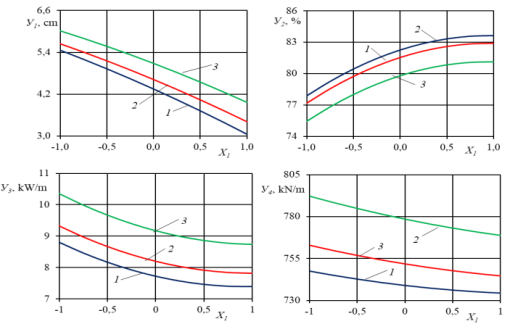
It can be seen from the obtained regression equations (1)–(4) and the graphical relationships constructed on their basis in Figure 1 that the lifting height of the soil at the bottom of the treated layer, the consumed specific power, and the specific draft resistance decreased with an increase in the rotational speed of the helical-toothed section of the rotary harrow, while the degree of soil crumbling increased.
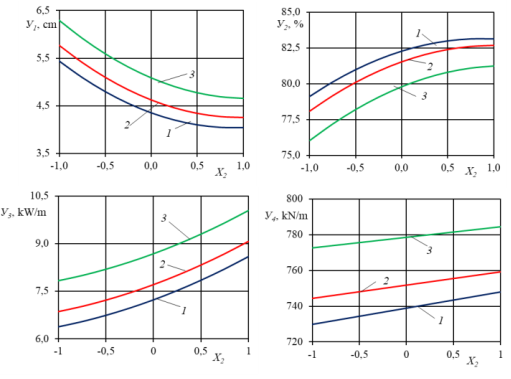
It can be seen from the regression equations (1)–(4) and the graphical relationships constructed on their basis in Figure 1 that an increase in the diameter of the helical tooth led to a decrease in the lifting height of the soil at the bottom of the treated layer and an increase in the other evaluation criteria.
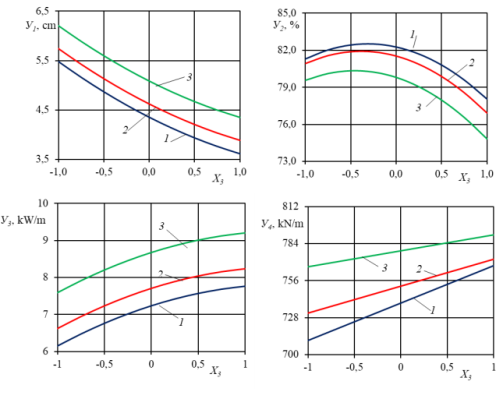
It can be seen from the regression equations (1)–(4) and the graphical relationships constructed on their basis in Figure 2 that with an increase in the length of the helical tooth, the lifting height of the soil at the bottom of the treated layer decreased, the quality of soil crumbling first increased and then decreased, while the consumed specific power and draft resistance increased.
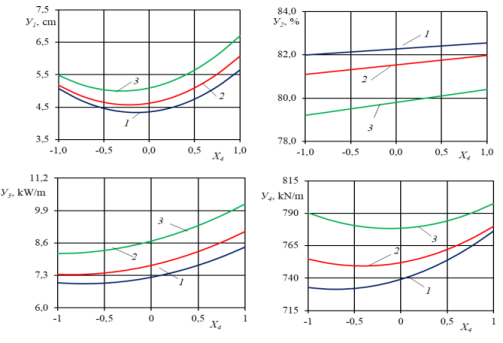
It can be seen from the regression equations (1)–(4) and the graphical relationships constructed on their basis in Figure 3 that with an increase in the helix rise angle of the tooth, the lifting height of the soil at the bottom of the treated layer first decreased and then increased, while the quality of soil crumbling, the consumed specific power, and the draft resistance increased.
3. Results
1, 2, and 3 correspond to X₅ values of -1, 0, and 1, respectively.

Download: Download full-size image

Figure 1. Effect of the rotational speed of the helical-toothed section of the rotary harrow (X1) on the criteria Y2, Y3, and Y4.
1, 2, and 3 correspond to X₅ values of -1, 0, and 1, respectively.

Download: Download full-size image

Figure 2. Effect of the diameter of the helical tooth of the rotary harrow (X2) on the criteria Y2, Y3, and Y4.
1, 2, and 3 correspond to X₅ values of -1, 0, and 1, respectively.

Download: Download full-size image

Figure 3. Effect of the length of the helical tooth of the rotary harrow (X3) on the criteria Y2, Y3, and Y4.
1, 2, and 3 correspond to X₅ values of -1, 0, and 1, respectively.

Download: Download full-size image

Figure 4. Effect of the helix rise angle of the rotary harrow tooth screw (X4) on the criteria Y2, Y3, and Y4.
In determining the values of the parameters that ensure the required level of work quality with low energy consumption, the regression equations (3.58)–(3.61) were jointly solved on a PC using the “Solver” tool of the Excel program for -1, 0, and 1.
When jointly solving the regression equations, the following conditions were adopted: criterion Y1, i.e. the lifting height of the soil at the bottom of the treated layer, should be greater than 5 cm; criterion Y2, i.e. the amount of fractions smaller than 25 mm, should not be less than 80%; criterion Y3, i.e. the consumed energy, and criterion Y4, i.e. the specific draft resistance, should have minimum values. The obtained results are presented in Table 2.
Table 2. Optimal values of the rotary harrow parameters.

Х5

Х1

Х2

Х3

Х4

Coded

Actual.

Coded

Actual.

Coded

Actual.

Coded

Actual.

Coded

Actual.

1

7

0,574

328,7

0,329

53,29

-0,845

163,1

-0,076

29,62

0

6

0,395

319,7

-0,453

45,46

-0,715

165,6

-0,239

28,80

-1

5

0,307

315,3

-0,721

42,78

-0,651

166,9

-0,490

27,55

Thus, in order to ensure the required quality of operation with low energy consumption at the агрегate travel speeds of 5–7 km/h, the rotational speed of the helical-toothed section of the rotary harrow should be 315–328 rpm, while the diameter and length of the helical tooth should be 42.78–53.26 mm and 163.1–166.9 mm, respectively, and the helix rise angle of the tooth screw should be within the range of 27°31′–29°31′.
At these values of the factors, the lifting height of the soil at the bottom of the treated layer is 5.23–5.36 cm, the degree of soil crumbling is 81.75–82.11%, the specific power consumed by the rotary harrow is 5.67 kW/m, and the specific draft resistance is 712.2–759.1 N/m.
4. Conclusions
In this study, the main constructive and technological parameters of the helical-toothed rotary harrow were optimized using the method of mathematical planning of multifactor experiments. The rotational speed of the working body, the diameter and length of the tooth, the helix rise angle, and the travel speed of the агрегate were taken as factors, and their influence on soil cultivation quality and energy performance indicators was investigated.
The experimental results were processed using statistical methods, reliable regression models were obtained, and the optimal operating modes of the harrow were determined. The obtained results are significant in that they make it possible to ensure high-quality soil crushing, reduce energy consumption, and increase the efficiency of the агрегate.
Abbreviations

X1

Rotational Speed of the Helical-toothed Section of the Rotary Harrow

X2

Diameter of the Helical Tooth of the Rotary Harrow, mm

X3

Length of the Helical Tooth of the Rotary Harrow, mm

X4

Helix Rise Angle of the Rotary Harrow Tooth

Author Contributions
Muhamedov Djobirxon: Conceptualization, Methodology, Project administration, Supervision, Writing – review & editing
Abduvaxobov Dilshod: Data curation, Formal Analysis, Methodology, Resources, Software
Ismatullayev Kaxramon: Validation, Visualization, Writing – original draft
Muxammadjonov Komiljon: Conceptualization, Investigation, Methodology, Project administration
To‘xtasinov Rustambek: Validation, Visualization, Writing – original draft
Conflicts of Interest
The authors declare no conflicts of interest.
References
[1] Agricultural Mechanics Moscow: Kolos Publishing House, 1968. 720 p.
[2] Fundamentals of Soil Failure Mechanics Moscow: Mashinostroenie Publishing House, 1968. 376 p.
[3] Rotary Soil-Cultivating Machines Moscow: Agropromizdat Publishing House, 1985. 240 p.
[4] “Kinematic Investigation of a Garden Soil-Cultivating Milling Machine with Planetary Drive” // Scientific Journal. 2020. No. 4. pp. 41–46.
[5] D. J. Mukhamedova. Research on the Substantiation of Parameters of Rotary Working Bodies // Scientific and Technical Journal. Tashkent, 2021. No. 2. pp. 23–31.
[6] D. Abduvakhobov. Energy-Saving Parameters of Soil-Cultivating Aggregates // Agro Ilm. Tashkent, 2020. No. 3. pp. 44–58.
[7] Tokhtakuziev. Analysis of the Kinematics of Rotary Working Bodies // Journal of Agricultural Machinery. 2019. No. 1. pp. 61–74.
[8] Q. Ismatullaev. Investigation of the Parameters of Soil-Cultivating Devices // Collection of Scientific Works on Agromechanics. 2022. pp. 37–49.
[9] B. M. Mirzaev. Parameters of the Working Bodies of Combined Aggregates // Bulletin of Technical Sciences. 2021. No. 5. pp. 72–80.
[10] N. R. Ravshanov. Methods of Mathematical Modeling // Scientific Bulletin. 2020. No. 4. pp. 15–27.
[11] F. M. Mamadaliev. Analysis of the Influence of Rotary Working Bodies on Soil // Journal of Agricultural Mechanization. 2021. No. 6. pp. 55–63.
[12] Theory of Experiment Moscow: Nauka Publishing House, 1971. 208 p.
[13] Experimental Design in the Search for Optimal Conditions Moscow: Nauka Publishing House, 1976. 279 p.
[14] A. I. Kobzar. Applied Mathematical Statistics. For Engineers and Researchers. Moscow: Fizmatlit Publishing House, 2006.816 p.
[15] N. Johnson, F. Lyon. Statistics and Experimental Design in Engineering and Science. Data Processing Methods / Translated from English. Moscow: Mir Publishing House, 1990. 610 p.
[16] RD Uz 63.03-98. Testing of Agricultural Machinery. Methods for Calculating the Economic Efficiency of Tested Agricultural Machinery. Official Edition. Tashkent, 1998. 49 p.
Cite This Article
  • APA Style

    Djobirxon, M., Dilshod, A., Kaxramon, I., Komiljon, M., Rustambek, T. (2026). Optimization of the Parameters of a Helical Rotary Harrow Based on the Method of Mathematical Planning of Experiments. International Journal of Mechanical Engineering and Applications, 14(2), 28-35. https://doi.org/10.11648/j.ijmea.20261402.11

    Copy | Download

    ACS Style

    Djobirxon, M.; Dilshod, A.; Kaxramon, I.; Komiljon, M.; Rustambek, T. Optimization of the Parameters of a Helical Rotary Harrow Based on the Method of Mathematical Planning of Experiments. Int. J. Mech. Eng. Appl. 2026, 14(2), 28-35. doi: 10.11648/j.ijmea.20261402.11

    Copy | Download

    AMA Style

    Djobirxon M, Dilshod A, Kaxramon I, Komiljon M, Rustambek T. Optimization of the Parameters of a Helical Rotary Harrow Based on the Method of Mathematical Planning of Experiments. Int J Mech Eng Appl. 2026;14(2):28-35. doi: 10.11648/j.ijmea.20261402.11

    Copy | Download

  • @article{10.11648/j.ijmea.20261402.11,
      author = {Muhamedov Djobirxon and Abduvaxobov Dilshod and Ismatullayev Kaxramon and Muxammadjonov Komiljon and To‘xtasinov Rustambek},
      title = {Optimization of the Parameters of a Helical Rotary Harrow Based on the Method of Mathematical Planning of Experiments},
      journal = {International Journal of Mechanical Engineering and Applications},
      volume = {14},
      number = {2},
      pages = {28-35},
      doi = {10.11648/j.ijmea.20261402.11},
      url = {https://doi.org/10.11648/j.ijmea.20261402.11},
      eprint = {https://article.sciencepublishinggroup.com/pdf/10.11648.j.ijmea.20261402.11},
      abstract = {This article investigates the optimization of the constructive and technological parameters of a helical rotary harrow using the method of mathematical planning of multifactor experiments. The study aims to improve the quality of soil cultivation while reducing energy consumption and increasing the operational efficiency of the unit. In the research, the influence of the rotational speed of the helical toothed section, tooth diameter, tooth length, helix rise angle, and aggregate travel speed on the quality and energy performance indicators of the rotary harrow was analyzed. The experiments were carried out based on the Plan B5 experimental design method. The lifting height of the bottom soil layer, soil crumbling degree, power consumption of the rotary harrow, and specific draft resistance were selected as evaluation criteria. Experimental data were processed using the PLANEX software package. The homogeneity of variance was evaluated using Cochran’s criterion, the significance of regression coefficients was determined by Student’s criterion, and the adequacy of the developed models was verified using Fisher’s criterion. As a result of the study, regression equations describing the relationships between the input factors and evaluation criteria were obtained, and the optimal constructive and technological parameters of the helical rotary harrow were determined. The obtained results demonstrate that the proposed parameter optimization improves soil cultivation quality, decreases energy consumption, and enhances the operational efficiency of the machine unit.},
     year = {2026}
    }
    

    Copy | Download

  • TY  - JOUR
    T1  - Optimization of the Parameters of a Helical Rotary Harrow Based on the Method of Mathematical Planning of Experiments
    AU  - Muhamedov Djobirxon
    AU  - Abduvaxobov Dilshod
    AU  - Ismatullayev Kaxramon
    AU  - Muxammadjonov Komiljon
    AU  - To‘xtasinov Rustambek
    Y1  - 2026/06/26
    PY  - 2026
    N1  - https://doi.org/10.11648/j.ijmea.20261402.11
    DO  - 10.11648/j.ijmea.20261402.11
    T2  - International Journal of Mechanical Engineering and Applications
    JF  - International Journal of Mechanical Engineering and Applications
    JO  - International Journal of Mechanical Engineering and Applications
    SP  - 28
    EP  - 35
    PB  - Science Publishing Group
    SN  - 2330-0248
    UR  - https://doi.org/10.11648/j.ijmea.20261402.11
    AB  - This article investigates the optimization of the constructive and technological parameters of a helical rotary harrow using the method of mathematical planning of multifactor experiments. The study aims to improve the quality of soil cultivation while reducing energy consumption and increasing the operational efficiency of the unit. In the research, the influence of the rotational speed of the helical toothed section, tooth diameter, tooth length, helix rise angle, and aggregate travel speed on the quality and energy performance indicators of the rotary harrow was analyzed. The experiments were carried out based on the Plan B5 experimental design method. The lifting height of the bottom soil layer, soil crumbling degree, power consumption of the rotary harrow, and specific draft resistance were selected as evaluation criteria. Experimental data were processed using the PLANEX software package. The homogeneity of variance was evaluated using Cochran’s criterion, the significance of regression coefficients was determined by Student’s criterion, and the adequacy of the developed models was verified using Fisher’s criterion. As a result of the study, regression equations describing the relationships between the input factors and evaluation criteria were obtained, and the optimal constructive and technological parameters of the helical rotary harrow were determined. The obtained results demonstrate that the proposed parameter optimization improves soil cultivation quality, decreases energy consumption, and enhances the operational efficiency of the machine unit.
    VL  - 14
    IS  - 2
    ER  - 

    Copy | Download

Author Information
  • Department of Mechanical Engineering, Namangan State Technical University, Namangan, Uzbekistan

    Biography: Muhamedov Djobirxon is a Doctor of Technical Sciences and professor widely recognized for his significant contributions to the field of machine elements. He is the author of numerous scientific articles and books, which are acknowledged as important and fundamental sources in the field. Due to his profound knowledge and high qualifications, he has earned respect and recognition both nationally and internationally. Currently, he works as a professor at Namangan State Technical University, where he shares his valuable knowledge with a new generation of engineers. Throughout his long academic career, the professor has supervised and educated many students, a large number of whom have later achieved great success in their respective fields. His dedication to scientific research, education, and the development of machine design has made him one of the leading scholars in his field, and his influence has been significantly reflected not only in academia but also in industry.

    Research Fields: Technological machines and equipment, manufacturing technology, machine science, machine parts, theory of machine mechanisms, development of new-generation mechanisms, and the implementation of energy- and resource-efficient technologies in industrial mechanical engineering.

  • Department of Mechanical Engineering, Namangan State Technical University, Namangan, Uzbekistan

    Biography: Abduvaxobov Dilshod is a Doctor of Philosophy (PhD) in Technical Sciences and an Associate Professor at the Department of Mechanics of the Namangan Engineering-Construction Institute. His research activity is mainly focused on agricultural machinery and mechanics, particularly the vibration analysis of agricultural machines and improving their operational efficiency. He has authored numerous scientific papers and publications in these fields, including articles indexed in international databases such as Scopus and Google Scholar. According to available academic metrics, he has published 3 Scopus-indexed articles, with 175 citations recorded on Google Scholar. His h-index is 7, and his i10-index is 4. His scientific contributions, along with his experience in teaching and mentoring students, have positioned him as a recognized specialist in the field of agricultural engineering and machine mechanics.

    Research Fields: Technological machines and equipment, manufacturing technology, machine science, machine parts, theory of machine mechanisms, creation of new-generation mechanisms, implementation of energy- and resource-efficient technologies in industrial mechanical engineering, agricultural and melioration machinery.

  • Department of Mechanical Engineering, Namangan State Technical University, Namangan, Uzbekistan

    Research Fields: Technological machines and equipment, manufacturing technology, machine science, machine parts, theory of machine mechanisms, creation of new-generation mechanisms.

  • Department of Mechanical Engineering, Namangan State Technical University, Namangan, Uzbekistan

    Biography: Muxammadjonov Komiljon is a PhD candidate in the Department of Mechanics at Namangan State Technical University. He is currently conducting research for his doctoral dissertation in the field of mechanical engineering and technological systems. He graduated from Namangan Engineering-Construction Institute in 2015 and received his master’s degree in Computer Systems and Software in 2022. His research interests include machine elements, mechanical systems, manufacturing technologies, and the optimization of technological processes. He has participated in several national and international scientific conferences and collaborative research projects. He has authored and co-authored a number of scientific publications focused on improving the efficiency, reliability, and performance of engineering systems. In addition to his research activities, he is actively involved in mentoring students and supporting the development of young researchers.

    Research Fields: Technological machines and equipment, manufacturing technology, machine science, machine parts, theory of machine mechanisms, development of new-generation mechanisms.


  • Department of Mechanical Engineering, Namangan State Technical University, Namangan, Uzbekistan

    Biography: To‘xtasinov Rustambek is a PhD candidate at the Department of Mechanics of Namangan State Technical University. He is currently conducting scientific research for his doctoral dissertation. He graduated from the Fergana Polytechnic Institute in 2020 and completed his master’s degree in “Mechanical Engineering Technology and Equipment (by Production)” at the same institution in 2022. In recent years, he has participated in a number of international scientific collaboration projects.

    Research Fields: Technological machines and equipment, manufacturing technology, machine science.